
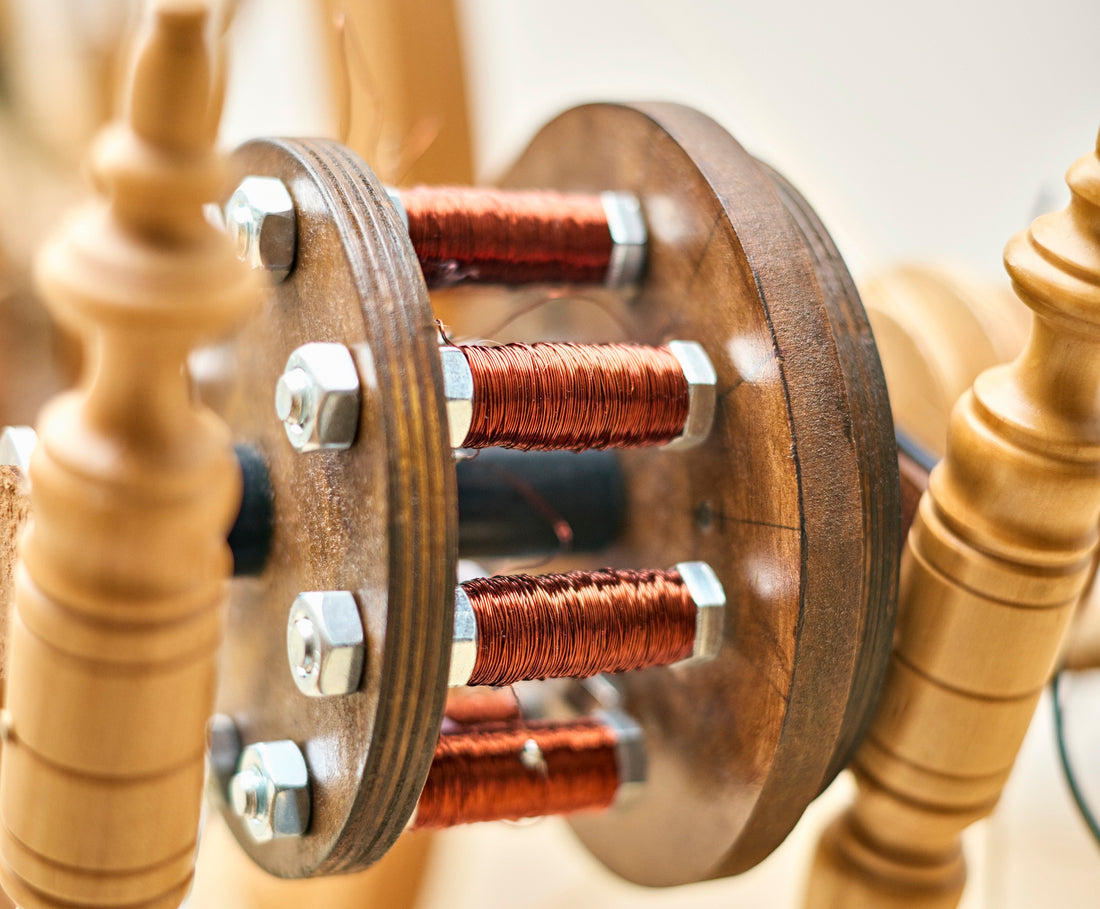

To address this issue, Michaela Johnston undertook a residency project in North Wales, focusing on the village of Pencader. The project explores how renewable energy technologies can be integrated into pre-existing practices and environments to generate electricity while minimising environmental harm. Pencader provided an interesting combination of living arrangements that relied on the surrounding environment to sustain their way of life. Many parts of rural Wales have geographical limitations particularly in the installation of solar panels due to the undulating landscape which presented a challenge when integrating productive renewable technologies.

During her time in Pencader and the conversations she engaged in with its residents, she began contemplating ways to harness energy from the cultural and creative practices inherent to the community. Specifically focusing on the spinning wheel as she believes it has symbolic value in capturing the significant hands-on creative craftmanship that ingrain Pencader. As part of this effort, she developed an attachment for a local spinner’s spinning wheel that converts the motion into electricity. Collaborating with the Spinner, she spun Welsh yarn, and crafted a unique branding that visually represented the watt- age generated with each ball of yarn. The varying thicknesses of yarn determines the amount of energy generated over a given period. This merges the realms of design, sustainability, and energy generation, offering an interesting perspective on the interplay between creativity and renewable resources.

She does not intend to answer questions, but to challenge the well-trodden paths of progress. With her project she invites everyone reading this to explore and imagine new ways of living and harnessing energy. Let us question what is known to us and seek innovative alternatives that harmonise with our planet’s intricate rhythms, to live a more conscious existence.
Text and images by @mitextiles_
Find out more: