
Access Denied
IMPORTANT! If you’re a store owner, please make sure you have Customer accounts enabled in your Store Admin, as you have customer based locks set up with EasyLockdown app. Enable Customer Accounts


1
/
of
16
Greeting Cards
Selvedge Magazine
Regular price
£2.50 GBP
Regular price
Sale price
£2.50 GBP
Unit price
/
per
Tax included.
Couldn't load pickup availability
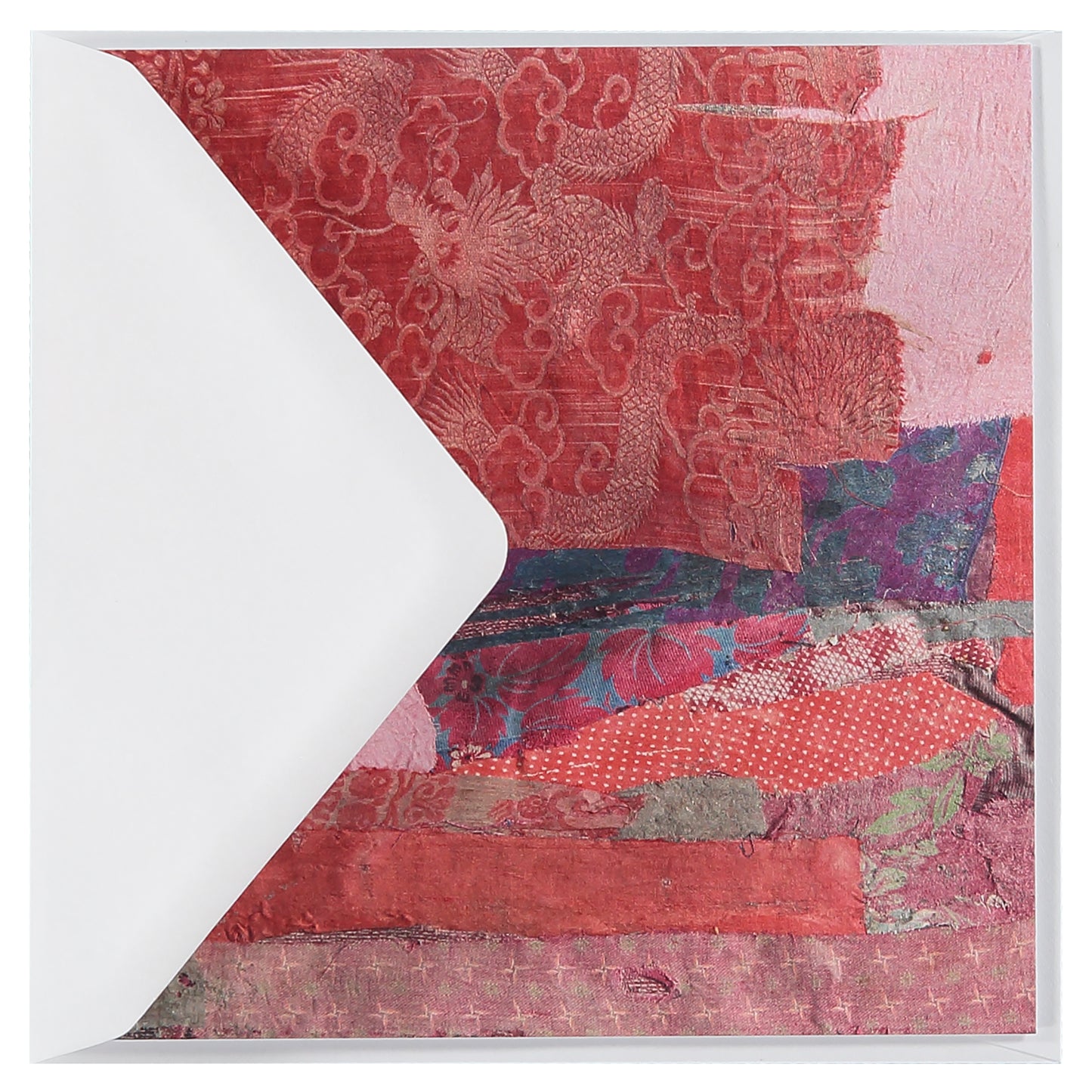
Greeting cards measuring 150 mm x 150 mm.
Available in 4 patterns: chintz, ge ba, ikat and kantha.
Boro was a common practice in Japan over the course of the 20th century. Derived from boroboro, meaning tattered or repaired, boro was a technique used by the poor to mend their clothes. Every single scrap of fabric, usually hemp, would be invested back into clothing. Individual garments were often indigo dyed and so the resulting effect is typically a ‘collage’ in varying shades of blue. Many examples survive and carry with them the histories and lives of numerous generations. To find out more see Selvedge Issue 70, page 13.
Kantha is a layered quilt traditionally made in India and Bangladesh. Worked by women in their homes as a way to extend the life of old saris and dhotis. Kanthas are made by stacking the old textiles on top of each other to create a padded quilt-like base. Embroidering threads are then taken from the woven border of the sari, and close running stitches darn the pieces together so that the join is almost invisible. Kanthas are generally household textiles; bed and floor cloths, blankets and wraps, or even shrouds. The earliest preserved examples date from the first half of the 19th century. To find out more see Selvedge Issue 33, page 71.
Ikat Textiles are made of plain woven cloth with characteristically soft edges between the colours that make up the pattern. Ikat involves a time-consuming technique of wrapping the warp and sometimes weft threads in bundles to create a resist, then dyeing them before weaving. Despite its complexity, the technique developed across different cultures and continents independently from at least 500ce, appearing in diverse locations from Pre-Columbian Peru and Guatemala, 10th century Yemen, Japan, Indonesia and India to Uzbekistan. Traditionally, ikat fabrics are used for garments and facings for paranjas; long cloaks Uzbek women wear to leave the house... To find out more see Selvedge Issue 14, page 55
Ge Ba textiles are found all over China. This tradition makes use of old and disused fabrics and repurposes them into garment linings and shoe soles. Made predominantly by women, Ge Ba is constructed from fabrics scraps stuck together with rice glue, to form rectangles, approximately 40x60 cm in size. The rectangles are composed of anything between ten and fifteen layers of fabrics, forming collages that revealing Chineses culture heritage and a bygone age when every scrap of fabric was precious, and there was no waste. To find out more see Selvedge issue 77, p. 53
Chintz is a crisp calico cloth with elaborate, hand painted, stained or printed floral patterns, originating from India. As calico cloth did not absorb colour easily master craftspeople developed complex natural dyeing processes that involved mordants and multiple dye baths to achieve chintz’s ornate designs. Chintz was introduced to Europe in the 1600s. Its bright fast colours derived from madder and indigo were easy to launder. The cloth proved so popular that by the late 17th century, more than a million pieces of chintz were being imported to the UK every year, captivating the western market and fuelling a revolution in dress. To find out more see Selvedge Issue 24, page 61.
Share
No reviews


Invalid password
Enter